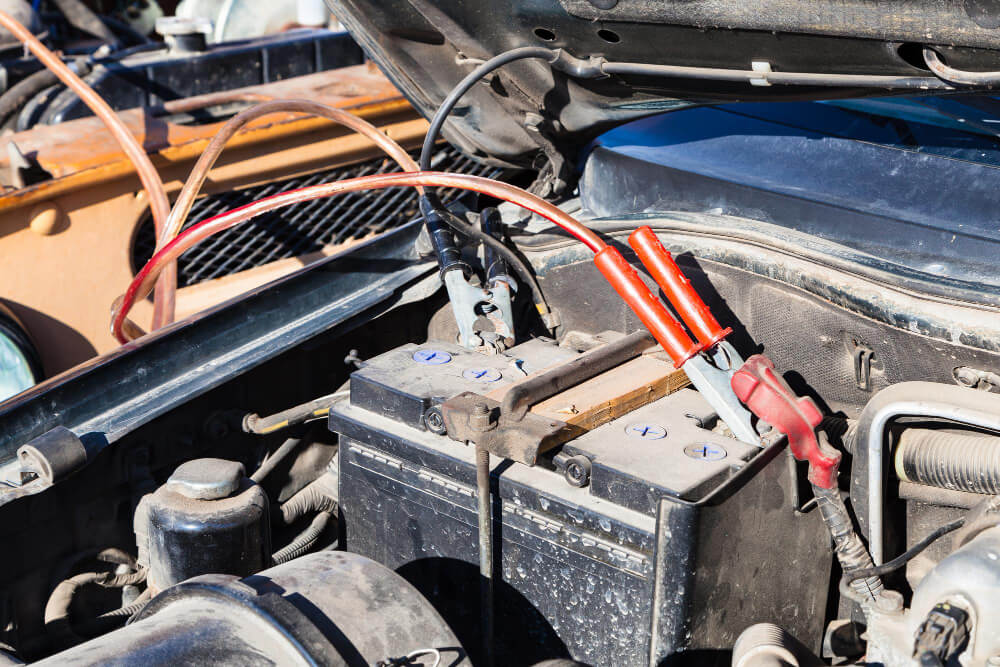
You got a jumpstart, merged back into traffic, ran a quick errand, and parked feeling relieved. Then an hour later you walked back to your car and it was completely dead again. That frustrating cycle is one of the most common situations we hear about at Bliss Towing Services, and it almost always comes down to the same misunderstanding. Most drivers assume that a jumpstart recharges the battery. It does not, at least not in the way most people think. This article breaks down exactly what a jumpstart does, how recharging actually works, what factors determine whether your battery truly recovers, and what practical steps Houston drivers should take after getting jumped. If you need help right now with jumpstarting your car, you can reach us any time at (281) 849-9991.
A jumpstart and a recharged battery are two completely different things, and understanding that difference is the key to everything else covered here.
When you get a jumpstart, a donor battery or a portable jump starter sends a short burst of electrical energy to your dead battery. That burst is just enough to get the engine cranking and firing. Once the engine is running, the jumpstart has done its job. It did not restore your battery’s charge level. It did not fix whatever caused the battery to die in the first place. It simply supplied enough temporary power to get things moving again.
Think of it like giving a stalled bicycle rider a push on a flat road. They are moving, but the moment they stop pedaling, they stop again. Getting the car started is only the first step. What happens after that is an entirely different matter.
Here is where the alternator enters the picture. Once the engine is running, your vehicle’s alternator takes over as the primary power source. It generates electrical current by converting mechanical energy from the running engine, and it channels that current back into the battery while the car is in motion. That process is the actual recharging.
Under the right conditions, a healthy battery in reasonably good shape can recover a meaningful level of charge after 30 or more minutes of steady driving, particularly at highway speeds where the engine maintains a consistent output.
A few things slow that recharging process down considerably:
A short trip to a nearby store after a jumpstart is usually not enough for the alternator to restore the battery to a safe and reliable charge level. This is why so many drivers end up stranded again within the same day.
Not every dead battery situation is the same, and whether a single jumpstart resolves the problem depends heavily on what caused the failure in the first place.
If the battery died because of an isolated and correctable cause, like leaving the interior lights on overnight, and the battery itself is relatively new and otherwise in good condition, a solid stretch of steady driving after the jump can bring it back to a functional charge level.
That said, there are situations where a jumpstart is really just a short-term fix:
In those situations, the jumpstart gets you moving, but the battery is already past the point where recharging alone solves the underlying problem.
Sometimes drivers keep replacing or jumping their battery and the problem keeps coming back. When that happens, the alternator is often the actual culprit.
If the alternator is failing, the battery will drain again even after a successful jumpstart and a long drive. The reason is straightforward: the alternator is not generating enough current to replenish the battery while the engine runs. The car ends up operating on a depleting power source with nothing refilling it.
A few signs that point toward the alternator rather than the battery:
Many auto parts retailers offer free battery and alternator testing that can help clarify which component is the actual problem. This matters because replacing the battery when the alternator is the root issue means the new battery will simply go dead again before long.
Houston’s climate adds a layer of urgency to all of this. Summer temperatures in the city regularly exceed 95 degrees Fahrenheit, and that heat accelerates battery wear, speeds up internal fluid evaporation, and compresses the window between a struggling battery and a completely failed one.
Here are the steps to take after a jumpstart:
In Houston’s heat, a marginal battery that might last a few more weeks in a cooler climate can fail within a single day. Taking the situation seriously after the first jump is the smarter and safer call.
Does jumpstarting a car recharge the battery? Not on its own. A jumpstart provides enough power to start the engine, and then the alternator gradually restores the battery’s charge while the engine runs. But that process takes time, works best under steady driving conditions, and only succeeds if the battery is still capable of holding a charge in the first place.
A jumpstart that works once is useful, but it is not a guarantee that the problem is solved. In Houston, where heat puts constant pressure on battery health, a battery that has already needed a jump is worth taking seriously before it leaves you stranded in a parking lot on a 100-degree afternoon.
When you need a jumpstart in Houston, Bliss Towing Services is available 24 hours a day, seven days a week at (281) 849-9991. Reach out to us and we will get you back on the road quickly, and help you determine whether the battery actually needs replacing before it turns into a bigger and more frustrating problem.